


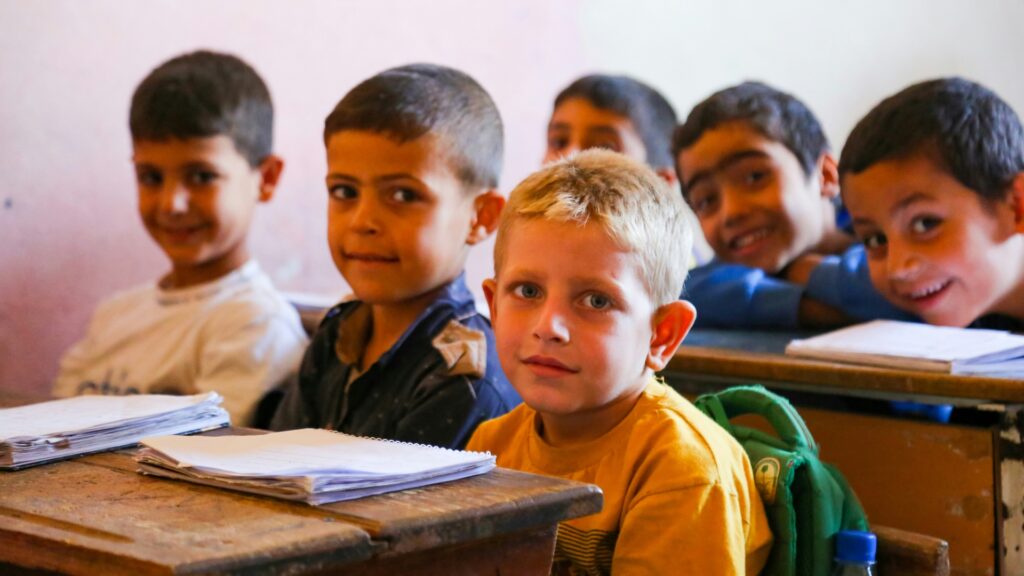
Despite decades of progress toward universal education, 2025 remains a year of deep challenge for children worldwide. Global data shows that hundreds of millions of children are still out of school, with significant disparities by region, income level, and crisis context. Education outcomes and poverty are closely linked: children living in poverty are far more likely to be excluded from schooling and learning opportunities. Progress toward key global commitments, including Sustainable Development Goal 4 (inclusive, equitable education), is off track, and without urgent investment the consequences will extend far beyond schooling alone.
This report compiles the most recent statistics on education access, out-of-school children, learning outcomes, and child poverty to provide a comprehensive picture of where the world stands in 2025 and why coordinated action is critical.
Global Out-of-school population
One of the most concerning education statistics in 2025 is the scale of children and youth not enrolled in school globally.
- According to the UNESCO Global Education Monitoring (GEM) Report, an estimated 272 million children and youth were out of school in 2023, a figure that remains highly relevant for 2025 projections and understanding trends. UNESCO
- This total includes approximately:
– 78 million primary school–age children
– 64 million lower secondary–age adolescents
– 130 million upper secondary–age youth UNESCO - The global reduction in out-of-school numbers has been minimal — only about 1% decline in nearly a decade, despite sustained global policy efforts. UNESCO
The persistence of such high out-of-school numbers has severe implications for poverty, learning, and economic futures.
Regional disparities in school access
Out-of-school rates vary dramatically by region, reflecting inequalities in income, conflict exposure, infrastructure, and investment:
- Sub-Saharan Africa consistently has the highest proportion of out-of-school children, with nearly three-quarters of the global out-of-school population located there. UNESCO
- Central and Southern Asia also accounts for a significant share at about 34% of global out-of-school children. UNESCO
- Middle East and North Africa reports show at least 30 million children not in school due to various conflicts and barriers to education. UNICEF
These disparities underscore that location — often determined by national income and conflict exposure — plays a central role in a child’s likelihood of being in school.

Poverty, education, and learning outcomes
Poverty and education access
Socioeconomic conditions remain among the strongest predictors of whether a child can access education. Children growing up in poverty face multiple, overlapping barriers that limit their ability to enroll in school and remain there.
- UNICEF’s state of the world’s children 2025 shows that more than 1 in 5 children in low- and middle-income countries are severely deprived in at least two areas critical to development, including education. UNICEF
- Global estimates further indicate that hundreds of millions of children live in multidimensional poverty, lacking access to basic necessities such as sanitation, nutrition, shelter, and schooling, with the highest rates found in sub-saharan africa and south asia. UNICEF
Beyond enrollment, economic hardship also affects school attendance, retention, and learning quality. Children from the poorest households are significantly more likely to fall behind academically or drop out entirely.
Learning Poverty
Access to school does not guarantee learning:
- Learning poverty — defined as the share of children unable to read and comprehend a simple text by age 10 — remains alarmingly high in many regions. Verdensbanken
- Globally, more than half of children in low- and middle-income countries cannot read with proficiency by the end of primary school, with the situation far worse in the poorest contexts. Verdensbanken
These statistics highlight that schooling without learning equity is insufficient: education systems must improve both access and quality.
Impact of crisis, conflict, and climate on education
Conflict and Disruption
Armed conflict continues to disrupt schooling:
- Crisis zones like Sudan, Gaza, and Afghanistan have seen dramatic reversals in attendance rates. For example, in Sudan around 16.5 million children were out of school due to ongoing conflict. UNICEF
War and instability erode educational infrastructure, forcing many children into unpaid work or early marriage instead of classrooms.
Climate-related disruptions
Education is also affected by climate shocks:
- A 2025 UNICEF report found that over 240 million children had their schooling interrupted by extreme weather events such as flooding and heatwaves across 85 countries. AP News
Climate impacts are a growing source of school disruption, disproportionately hitting children in low-income and disaster-prone areas.

Poverty and economic impacts of education exclusion
Education exclusion has far-reaching economic consequences:
- Estimates suggest that out-of-school populations and education gaps could cost the global economy up to $10 trillion per year due to lost productivity and diminished human capital. UNESCO
- Reducing poverty through universal primary and secondary education could more than halve global poverty rates if adults complete these levels of schooling. UNESCO
Economic models show that education is one of the most effective levers for poverty reduction and long-term development.
Gender, inequality, and vulnerable groups
Inequality within countries also affects who is excluded:
- Girls are disproportionately out of school in conflict and conservative regions, with notable exclusion in Afghanistan where secondary education for girls has been banned in some contexts. globalpartnership.org
- Children with disabilities and those in the poorest households face the highest barriers to sustained school participation. Global Education Magazine
Addressing both gender and socioeconomic inequality is vital to achieving universal education.
Progress, targets, and future outlook
Despite these challenges, some progress has been made:
- Since 2015, more children are enrolled and completing secondary school than ever before, and overall schooling rates have increased in many countries. UNESCO
However:
- Global education targets, such as Sustainable Development Goal 4 (quality education for all), are off track. Some estimates suggest by 2030 as many as 300 million children may still lack basic numeracy and literacy skills without significant intervention. unicefusa.org
To reverse these trends, international cooperation, sustained funding, and targeted policies are urgently needed.
A worldwide crisis for education
The global education crisis in 2025 is deeply intertwined with poverty, inequality, and crisis contexts. While progress has been made in some areas, the persistent lack of equitable access and meaningful learning outcomes demands renewed focus, investment, and innovative solutions. Ensuring every child can go to school and learn — regardless of circumstance — remains one of the most powerful tools for poverty reduction, human development, and economic resilience worldwide.


